Only about 1 in 24 clients with a problem will tell you about it, a directional figure from long-standing research on silent attrition. In our experience, the clients who stay quiet rarely leave over the quality of the legal work. They leave over an invoice nobody explained, a matter that went dark for three weeks, or the silence after the final bill.
That is a law firm client feedback problem, and it sits in plain sight. Most firms run an annual satisfaction survey or an NPS score, send it to a friendly contact, and file the results with marketing. The score comes back high. The relationship keeps cooling underneath it.
Our founder, Steven Keith, wrote this report as the companion to his book, From Clients to Capital, and to his August 26 CX Pillar webinar with the Legal Sales and Service Organization (LSSO). Steven has spent twenty years building client experience programs for AmLaw 200 firms, and his teams have run tens of thousands of interviews with the general counsel, legal operations leads, and procurement teams who decide which firms keep the work.
The report includes:
Corporate legal clients go quiet because almost nobody at their law firm has asked them a question worth answering. Satisfaction has little to do with it.
Law firm NPS is a weak predictor of whether a corporate client stays. Fred Reichheld introduced the likelihood-to-recommend question in Harvard Business Review in 2003 as the one number a company needed to grow, and for a retailer with millions of interchangeable customers, it does that job. A law firm has neither millions of clients nor interchangeable ones.
Legal work also rarely moves on recommendations. Corporate legal is competitive and conflict-bound, and a general counsel may value a firm precisely because a rival cannot use it. Corporate legal client satisfaction scores share the blind spot: a client can be entirely satisfied and still be moving work to a cheaper provider for reasons the survey never raised.
The deeper issue is what the score measures. NPS and satisfaction ratings are attitudinal. They tell you whether a client is annoyed this quarter. Retention decisions are behavioral: which firm gets the next matter, who stays on the panel, what moves to the in-house team. A firm that wants to predict client loss has to ask about the behavior.
So where does a survey belong? Inside a tiered program, sized to the value of each relationship. When an LSSO webinar attendee asked Steven whether surveys have any place at all, his answer was that a reframed survey becomes an asset quickly. The report's listening cadence blueprint sets three tiers.
Top relationships get structured interviews and live check-ins on every matter, led by the relationship partner and a CX owner. Key clients get a short structured conversation at each matter close, led by the relationship partner. Transactional clients get a brief digital pulse from the CX team, once a year and after each matter. That third tier is where a short survey or an NPS question belongs.
For your top twenty clients, replace the score with a conversation. For the long tail, a short survey works well, as long as someone owns what comes back.
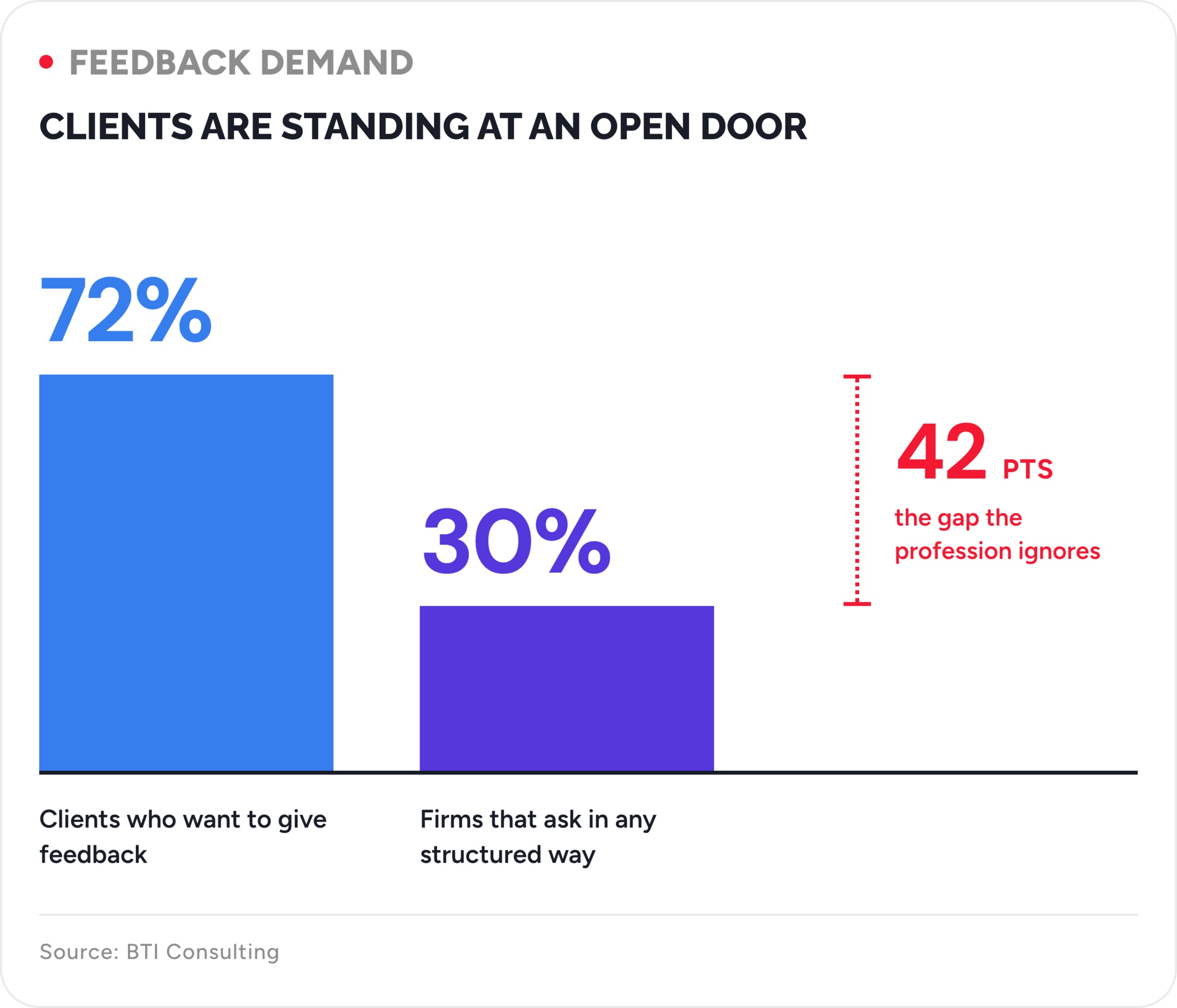
BTI Consulting finds that 72% of corporate clients want to give their law firm feedback, while only about 30% of firms ask for it in any structured way. That 42-point gap is the clearest measure of what we call the profession's broken curiosity. Clients are ready to tell outside counsel what would keep or grow the relationship. Most firms never open the conversation.
The annual survey most firms run in its place has three structural problems:
Compare that with the firms known for client service. BTI, which has conducted more than 30,000 corporate counsel interviews over 25 years, finds that top-performing firms run 70 to 250 structured client interviews a year, in person, led by people trained to hear what a client leaves out of a survey box.
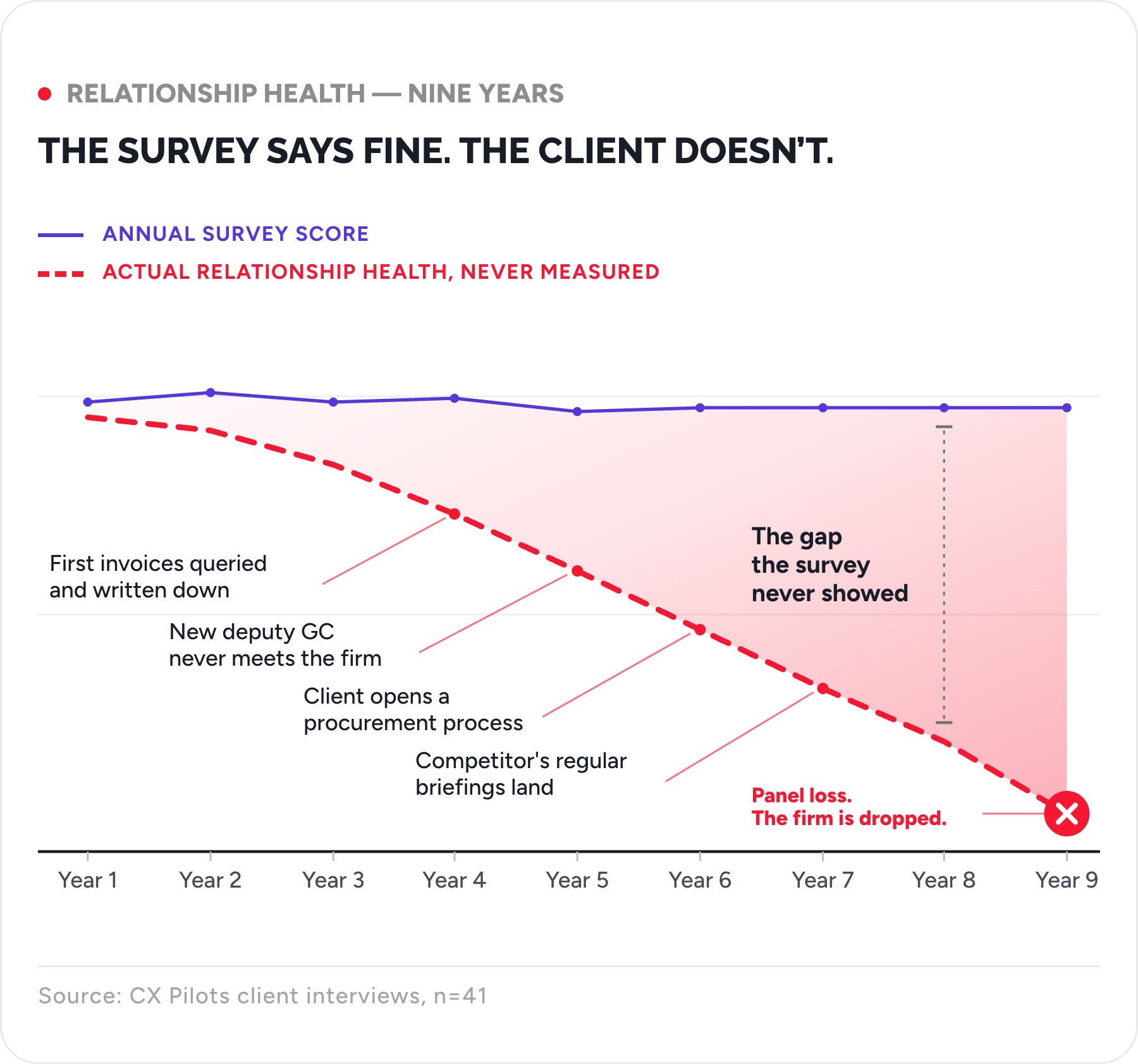
The report opens with a story that shows how this happens. A regional firm represented a manufacturing client for nine years through employment matters, a couple of acquisitions, and the usual commercial disputes. The relationship partner had known the general counsel since before either held the title. Every year the survey came back with nines on responsiveness and warm notes about the team.
Then the work thinned. A financing matter went to a larger competitor. A block of routine employment work moved to a legal operations vendor, and the partner assumed it was a budget year. Meanwhile a new deputy general counsel had never met anyone at the firm. Three invoices had been queried and written down after a junior partner took over billing. The client had opened a procurement process the firm was never invited into, and a younger competitor had spent a year sending short regulatory briefings while the firm sent holiday cards.
Eighteen months later, the general counsel called to say the company was consolidating outside counsel, and the firm had missed the panel. Every one of those signals was visible somewhere inside the firm. A satisfaction score had no way to register any of them.
Every failed program we examine traces back to five compounding design decisions. Each is fixable on its own.
Confidentiality is the other reason firms give for skipping the work. The rules of professional conduct govern how client information is handled. They place no bar on asking a client how the relationship is going, recording the answer with care, and acting on it. Treat the ethics rules as a design requirement for the program.
Together, the five flaws explain how a firm scores well on its own survey in the spring and loses the account by fall.
Even a well-designed feedback program covers roughly one tenth of the legal client experience a firm should manage. We call the whole the Managed Client Experience System. Feedback is one domain, and the other nine sit unmanaged at most firms.
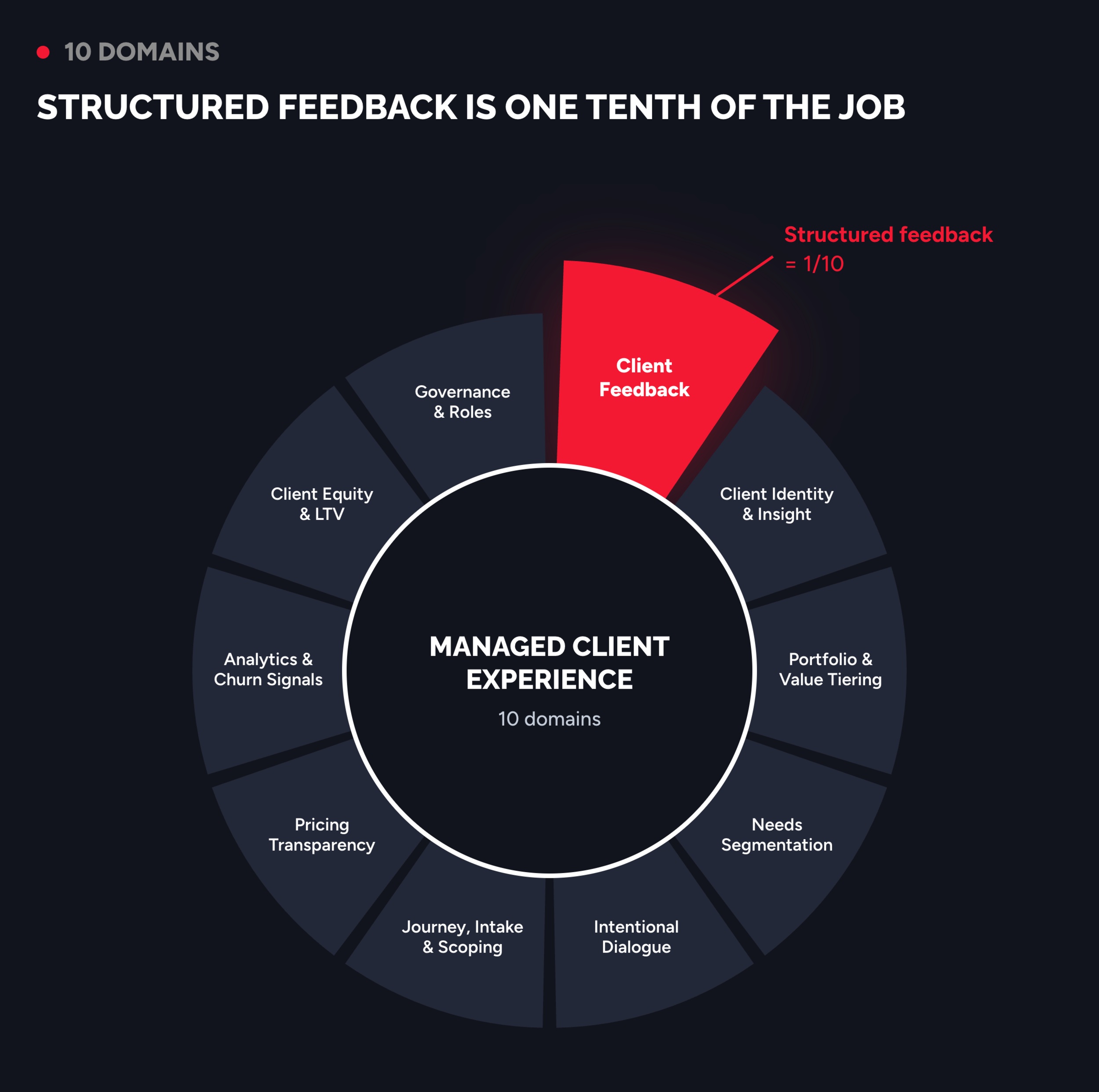
The other nine are client identity and insight, portfolio and value tiering, needs segmentation, intentional dialogue, journey and intake design, pricing transparency, analytics and churn signals, client equity and lifetime value, and governance and roles. Each is a separate discipline with its own tools and its own owner, and each maps to a chapter of From Clients to Capital. A firm can run a flawless survey while doing none of them.
Managing all ten changes what a firm competes for. A firm managing one domain pitches matter by matter. A firm managing the whole experience competes for share of client: the percentage of a client's total legal spend it captures against competing firms, alternative providers, and the client's own in-house team. In the report's illustrative model, a firm holds $4.8 million of a $40 million client, a 12% share. Most firms have never run that calculation for a single client, so the room to grow inside relationships they already hold stays invisible.
Steven argues that what a firm chooses to ask is one of its easiest differentiators, because clients remember the question long after they forget the score they gave. At the webinar he shared one client's reaction: their outside counsel asked the same things their car dealership asked after a service visit. The report's five moves turn curiosity into an operating discipline, and all five run without a new platform or a multi-year program.
The six questions at the center of the inquiry come straight from the report:
Two details do real work. The word "single" in the second question forces one answer in place of a list. The menu in the fifth gives the client a starting point, since most people struggle to name their own frustration cold.
The questions pay off fast. A regional firm replaced its eighteen-question annual survey with a six-question conversation led by a senior partner. In the first round, its second-largest client mentioned, without being asked directly, that it had moved a year of regulatory work to a boutique because the firm had been slow to staff the last matter. Six years of surveys had missed it, because the survey never asked where the work was going. The firm won the regulatory work back the next quarter, and that one conversation paid for the program.
The report pairs the questions with a respondent map for finding who actually decides at each client, and a signal dashboard that tracks leading indicators months before they reach a survey: queried invoices, matters closing with none reopening, time since anyone spoke with the economic buyer, and decision-makers no one at the firm has met.
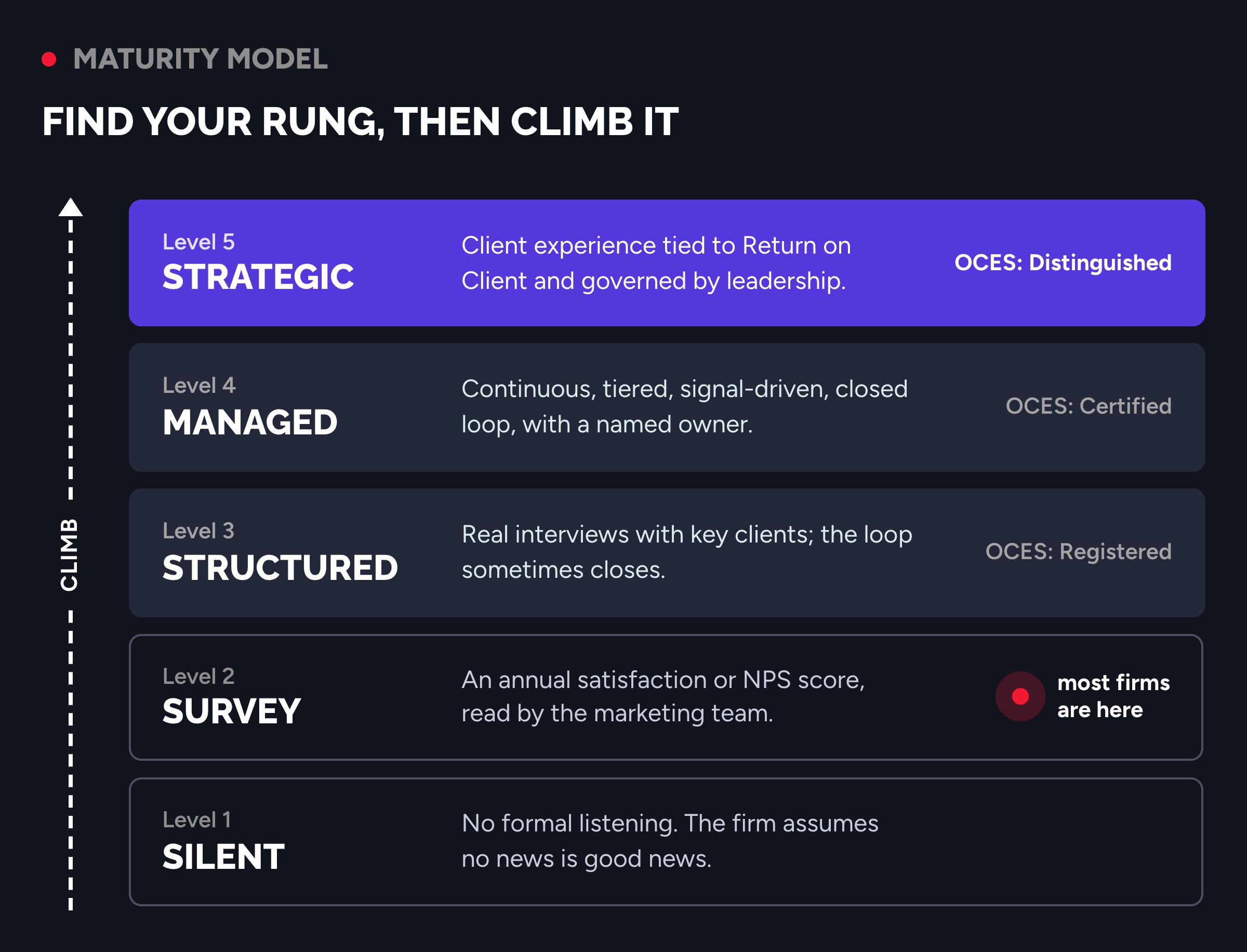
Most law firms sit at level two. The model gives a firm an honest read on where it stands and names the next rung.
The immediate goal is the next rung. Each level from three upward maps to a tier of the proposed Outside Counsel Experience Standard, so maturity work and credentialing readiness move together.
The Mansfield Rule showed what happens when corporate buyers attach an independent credential to their spending. More than 300 firms now pursue Mansfield certification each cycle, and general counsel cite it in panel decisions. Apply the Mansfield Rule structure to client experience and you get the Outside Counsel Experience Standard, the credential the report proposes.
An independent body would certify firms across seven weighted domains, with client outcomes and commercial linkage carrying the most weight at 20%. Claims are verified with the firm's own clients before a tier is granted. The four tiers run from Registered to Certified, Distinguished, and Eminent, and buyers would set Certified as the floor for RFP eligibility with a single clause.
Firms that build a listening discipline now will hold the evidence when buyers ask. Firms still sending an annual survey will have a score and little behind it.
A serious client listening program costs a law firm a low six-figure sum a year. In the report's illustrative model, a $150,000 program sits against $2.4 million in annual fees from one cooling client and $38 million across the top twenty. Read as return on client, saving one account pays for the program many times over. When Steven asked LSSO webinar attendees what saving one panel spot a year would be worth, the answers in the chat came back fast: millions, and multiples of the investment.
The same logic applies to relationships that live in one partner's head. Decipher Investigative Intelligence found that roughly 62% of lateral partners fail to bring over the business they projected. Firms file that under lateral-hiring risk. It is also a measure of how thinly the firm understood those relationships in the first place, and a strong argument for keeping client knowledge in a system the firm owns.
Five numbers keep the program funded past the first budget review: retention of top relationships, share of client, return on client, relationships flagged at risk, and closed-loop rate.
The reset needs one quarter and the discipline to use it.
Start with fifteen clients. In most firms, the first round surfaces at least one at-risk relationship worth more than the entire program. Firms with thousands of clients can pilot inside a single practice group, and partners tend to join quickly once they see what comes back.
One thing to do this week: pick your top five clients and list every decision-maker at each, the general counsel, the practice-area deputies, the legal operations lead, and any procurement contact. Mark the ones someone at your firm has actually met. The gap between that list and your survey list is your exposure.
How should a law firm use NPS?
As a light pulse for transactional clients, inside a tiered listening program. NPS measures attitude, and law firm client retention turns on behavior, so top clients need structured conversations with the actual decision-makers, tied to named owners and deadlines.
What percentage of corporate clients want to give their law firm feedback?
According to BTI Consulting, 72% of corporate clients want to give their law firm feedback, while only about 30% of firms ask for it in any structured way, a 42-point gap between client willingness and firm practice.
Why do annual law firm client satisfaction surveys fail to predict client loss?
Annual surveys measure a general impression once a year, months after the work that shaped it, and usually reach the friendliest contact instead of the decision-makers. A client can score a firm well while moving work to a competitor, the pattern the report documents in a nine-year relationship that ended in a panel loss.
What predicts law firm client retention better than a satisfaction score?
Behavioral signals from billing and matter data: a declining trend in matters opened, invoices queried or written down, time since anyone spoke with the economic buyer, and decision-makers the firm has never met. These appear months before a survey registers a problem.
What is the Managed Client Experience System?
It is the ten-domain framework CX Pilots uses to describe the full scope of client experience management for professional services firms. Structured client feedback is one domain. The other nine are client identity, value tiering, needs segmentation, intentional dialogue, journey and intake design, pricing transparency, churn analytics, client lifetime value, and governance.
What is share of client in legal services, and why does it matter?
Share of client is the percentage of a client's total legal spend that one firm captures, against competing firms, alternative legal providers, and the client's own in-house team. Most firms have never calculated it, so they have never seen how much room exists to grow inside relationships they already hold, growth that is generally cheaper than winning a new client.
What is the Outside Counsel Experience Standard?
It is a proposed independent credential for law firm client experience, modeled on the Mansfield Rule. It would certify firms against measured client outcomes and give corporate buyers a way to require evidence of a firm's client listening discipline.
How much does a law firm client listening program cost?
The report estimates a low six-figure annual cost for a properly run program. The fees at risk in a single cooling client relationship can run into the millions, and across a firm's top twenty clients into the tens of millions.
Does client feedback collection violate rules of professional conduct?
No. Confidentiality rules govern how client information is handled. They place no bar on a firm asking a client how the relationship is going. The ethics rules are a reason to design the program carefully.
The Broken Curiosity of Law Firms gives managing partners, practice group leaders, and business development and marketing leaders the data, the diagnostic instruments, and the 90-day plan to move off the annual survey. Inside are the six-question inquiry primer, the respondent map, the signal dashboard, the maturity self-placement, and the governance one-pager, along with the full money case.
If you attended Steven Keith's LSSO webinar, this is the complete version of the argument, with every instrument he referenced. If you found this page through search, start with the maturity self-placement and see where your firm sits before your competitors, or your clients, tell you.
Ready to get curious before a client goes quiet for good? CX Pilots leads client-listening engagements for law firms. Book a free 30-minute consult and bring your toughest CX challenge. Book a time here.
Found this helpful? Check out Steven Keith's book here on Amazon.

Only about 1 in 24 clients with a problem will tell you about it, a directional figure from long-standing research on silent attrition. In our experience, the clients who stay quiet rarely leave over the quality of the legal work. They leave over an invoice nobody explained, a matter that went dark for three weeks, or the silence after the final bill.
That is a law firm client feedback problem, and it sits in plain sight. Most firms run an annual satisfaction survey or an NPS score, send it to a friendly contact, and file the results with marketing. The score comes back high. The relationship keeps cooling underneath it.
Our founder, Steven Keith, wrote this report as the companion to his book, From Clients to Capital, and to his August 26 CX Pillar webinar with the Legal Sales and Service Organization (LSSO). Steven has spent twenty years building client experience programs for AmLaw 200 firms, and his teams have run tens of thousands of interviews with the general counsel, legal operations leads, and procurement teams who decide which firms keep the work.
The report includes:
Corporate legal clients go quiet because almost nobody at their law firm has asked them a question worth answering. Satisfaction has little to do with it.
Law firm NPS is a weak predictor of whether a corporate client stays. Fred Reichheld introduced the likelihood-to-recommend question in Harvard Business Review in 2003 as the one number a company needed to grow, and for a retailer with millions of interchangeable customers, it does that job. A law firm has neither millions of clients nor interchangeable ones.
Legal work also rarely moves on recommendations. Corporate legal is competitive and conflict-bound, and a general counsel may value a firm precisely because a rival cannot use it. Corporate legal client satisfaction scores share the blind spot: a client can be entirely satisfied and still be moving work to a cheaper provider for reasons the survey never raised.
The deeper issue is what the score measures. NPS and satisfaction ratings are attitudinal. They tell you whether a client is annoyed this quarter. Retention decisions are behavioral: which firm gets the next matter, who stays on the panel, what moves to the in-house team. A firm that wants to predict client loss has to ask about the behavior.
So where does a survey belong? Inside a tiered program, sized to the value of each relationship. When an LSSO webinar attendee asked Steven whether surveys have any place at all, his answer was that a reframed survey becomes an asset quickly. The report's listening cadence blueprint sets three tiers.
Top relationships get structured interviews and live check-ins on every matter, led by the relationship partner and a CX owner. Key clients get a short structured conversation at each matter close, led by the relationship partner. Transactional clients get a brief digital pulse from the CX team, once a year and after each matter. That third tier is where a short survey or an NPS question belongs.
For your top twenty clients, replace the score with a conversation. For the long tail, a short survey works well, as long as someone owns what comes back.
BTI Consulting finds that 72% of corporate clients want to give their law firm feedback, while only about 30% of firms ask for it in any structured way. That 42-point gap is the clearest measure of what we call the profession's broken curiosity. Clients are ready to tell outside counsel what would keep or grow the relationship. Most firms never open the conversation.
The annual survey most firms run in its place has three structural problems:
Compare that with the firms known for client service. BTI, which has conducted more than 30,000 corporate counsel interviews over 25 years, finds that top-performing firms run 70 to 250 structured client interviews a year, in person, led by people trained to hear what a client leaves out of a survey box.
The report opens with a story that shows how this happens. A regional firm represented a manufacturing client for nine years through employment matters, a couple of acquisitions, and the usual commercial disputes. The relationship partner had known the general counsel since before either held the title. Every year the survey came back with nines on responsiveness and warm notes about the team.
Then the work thinned. A financing matter went to a larger competitor. A block of routine employment work moved to a legal operations vendor, and the partner assumed it was a budget year. Meanwhile a new deputy general counsel had never met anyone at the firm. Three invoices had been queried and written down after a junior partner took over billing. The client had opened a procurement process the firm was never invited into, and a younger competitor had spent a year sending short regulatory briefings while the firm sent holiday cards.
Eighteen months later, the general counsel called to say the company was consolidating outside counsel, and the firm had missed the panel. Every one of those signals was visible somewhere inside the firm. A satisfaction score had no way to register any of them.
Every failed program we examine traces back to five compounding design decisions. Each is fixable on its own.
Confidentiality is the other reason firms give for skipping the work. The rules of professional conduct govern how client information is handled. They place no bar on asking a client how the relationship is going, recording the answer with care, and acting on it. Treat the ethics rules as a design requirement for the program.
Together, the five flaws explain how a firm scores well on its own survey in the spring and loses the account by fall.
Even a well-designed feedback program covers roughly one tenth of the legal client experience a firm should manage. We call the whole the Managed Client Experience System. Feedback is one domain, and the other nine sit unmanaged at most firms.
The other nine are client identity and insight, portfolio and value tiering, needs segmentation, intentional dialogue, journey and intake design, pricing transparency, analytics and churn signals, client equity and lifetime value, and governance and roles. Each is a separate discipline with its own tools and its own owner, and each maps to a chapter of From Clients to Capital. A firm can run a flawless survey while doing none of them.
Managing all ten changes what a firm competes for. A firm managing one domain pitches matter by matter. A firm managing the whole experience competes for share of client: the percentage of a client's total legal spend it captures against competing firms, alternative providers, and the client's own in-house team. In the report's illustrative model, a firm holds $4.8 million of a $40 million client, a 12% share. Most firms have never run that calculation for a single client, so the room to grow inside relationships they already hold stays invisible.
Steven argues that what a firm chooses to ask is one of its easiest differentiators, because clients remember the question long after they forget the score they gave. At the webinar he shared one client's reaction: their outside counsel asked the same things their car dealership asked after a service visit. The report's five moves turn curiosity into an operating discipline, and all five run without a new platform or a multi-year program.
The six questions at the center of the inquiry come straight from the report:
Two details do real work. The word "single" in the second question forces one answer in place of a list. The menu in the fifth gives the client a starting point, since most people struggle to name their own frustration cold.
The questions pay off fast. A regional firm replaced its eighteen-question annual survey with a six-question conversation led by a senior partner. In the first round, its second-largest client mentioned, without being asked directly, that it had moved a year of regulatory work to a boutique because the firm had been slow to staff the last matter. Six years of surveys had missed it, because the survey never asked where the work was going. The firm won the regulatory work back the next quarter, and that one conversation paid for the program.
The report pairs the questions with a respondent map for finding who actually decides at each client, and a signal dashboard that tracks leading indicators months before they reach a survey: queried invoices, matters closing with none reopening, time since anyone spoke with the economic buyer, and decision-makers no one at the firm has met.
Most law firms sit at level two. The model gives a firm an honest read on where it stands and names the next rung.
The immediate goal is the next rung. Each level from three upward maps to a tier of the proposed Outside Counsel Experience Standard, so maturity work and credentialing readiness move together.
The Mansfield Rule showed what happens when corporate buyers attach an independent credential to their spending. More than 300 firms now pursue Mansfield certification each cycle, and general counsel cite it in panel decisions. Apply the Mansfield Rule structure to client experience and you get the Outside Counsel Experience Standard, the credential the report proposes.
An independent body would certify firms across seven weighted domains, with client outcomes and commercial linkage carrying the most weight at 20%. Claims are verified with the firm's own clients before a tier is granted. The four tiers run from Registered to Certified, Distinguished, and Eminent, and buyers would set Certified as the floor for RFP eligibility with a single clause.
Firms that build a listening discipline now will hold the evidence when buyers ask. Firms still sending an annual survey will have a score and little behind it.
A serious client listening program costs a law firm a low six-figure sum a year. In the report's illustrative model, a $150,000 program sits against $2.4 million in annual fees from one cooling client and $38 million across the top twenty. Read as return on client, saving one account pays for the program many times over. When Steven asked LSSO webinar attendees what saving one panel spot a year would be worth, the answers in the chat came back fast: millions, and multiples of the investment.
The same logic applies to relationships that live in one partner's head. Decipher Investigative Intelligence found that roughly 62% of lateral partners fail to bring over the business they projected. Firms file that under lateral-hiring risk. It is also a measure of how thinly the firm understood those relationships in the first place, and a strong argument for keeping client knowledge in a system the firm owns.
Five numbers keep the program funded past the first budget review: retention of top relationships, share of client, return on client, relationships flagged at risk, and closed-loop rate.
The reset needs one quarter and the discipline to use it.
Start with fifteen clients. In most firms, the first round surfaces at least one at-risk relationship worth more than the entire program. Firms with thousands of clients can pilot inside a single practice group, and partners tend to join quickly once they see what comes back.
One thing to do this week: pick your top five clients and list every decision-maker at each, the general counsel, the practice-area deputies, the legal operations lead, and any procurement contact. Mark the ones someone at your firm has actually met. The gap between that list and your survey list is your exposure.
How should a law firm use NPS?
As a light pulse for transactional clients, inside a tiered listening program. NPS measures attitude, and law firm client retention turns on behavior, so top clients need structured conversations with the actual decision-makers, tied to named owners and deadlines.
What percentage of corporate clients want to give their law firm feedback?
According to BTI Consulting, 72% of corporate clients want to give their law firm feedback, while only about 30% of firms ask for it in any structured way, a 42-point gap between client willingness and firm practice.
Why do annual law firm client satisfaction surveys fail to predict client loss?
Annual surveys measure a general impression once a year, months after the work that shaped it, and usually reach the friendliest contact instead of the decision-makers. A client can score a firm well while moving work to a competitor, the pattern the report documents in a nine-year relationship that ended in a panel loss.
What predicts law firm client retention better than a satisfaction score?
Behavioral signals from billing and matter data: a declining trend in matters opened, invoices queried or written down, time since anyone spoke with the economic buyer, and decision-makers the firm has never met. These appear months before a survey registers a problem.
What is the Managed Client Experience System?
It is the ten-domain framework CX Pilots uses to describe the full scope of client experience management for professional services firms. Structured client feedback is one domain. The other nine are client identity, value tiering, needs segmentation, intentional dialogue, journey and intake design, pricing transparency, churn analytics, client lifetime value, and governance.
What is share of client in legal services, and why does it matter?
Share of client is the percentage of a client's total legal spend that one firm captures, against competing firms, alternative legal providers, and the client's own in-house team. Most firms have never calculated it, so they have never seen how much room exists to grow inside relationships they already hold, growth that is generally cheaper than winning a new client.
What is the Outside Counsel Experience Standard?
It is a proposed independent credential for law firm client experience, modeled on the Mansfield Rule. It would certify firms against measured client outcomes and give corporate buyers a way to require evidence of a firm's client listening discipline.
How much does a law firm client listening program cost?
The report estimates a low six-figure annual cost for a properly run program. The fees at risk in a single cooling client relationship can run into the millions, and across a firm's top twenty clients into the tens of millions.
Does client feedback collection violate rules of professional conduct?
No. Confidentiality rules govern how client information is handled. They place no bar on a firm asking a client how the relationship is going. The ethics rules are a reason to design the program carefully.
The Broken Curiosity of Law Firms gives managing partners, practice group leaders, and business development and marketing leaders the data, the diagnostic instruments, and the 90-day plan to move off the annual survey. Inside are the six-question inquiry primer, the respondent map, the signal dashboard, the maturity self-placement, and the governance one-pager, along with the full money case.
If you attended Steven Keith's LSSO webinar, this is the complete version of the argument, with every instrument he referenced. If you found this page through search, start with the maturity self-placement and see where your firm sits before your competitors, or your clients, tell you.
Ready to get curious before a client goes quiet for good? CX Pilots leads client-listening engagements for law firms. Book a free 30-minute consult and bring your toughest CX challenge. Book a time here.
Found this helpful? Check out Steven Keith's book here on Amazon.