I've spent twenty years building client experience programs for high-trust professional services firms. My team has run tens of thousands of client interviews across AmLaw 200 firms, and one number keeps showing up in that work: only 1 in 24 clients with a problem will actually tell you. About half of the other 23 quietly take their work elsewhere.
Across that work, I've never once traced a lost client back to the quality of the legal work. It's always something quieter: an invoice nobody explained, a matter that went dark, the silence after the final bill. Firms lose clients they were certain they had, and the damage almost always gets dismissed as "soft skills" stuff, right up until it shows up as a lost panel spot.
A client relationship produces two very different readings over time: what the annual survey says, and what's actually happening underneath it. The two rarely move together for long.
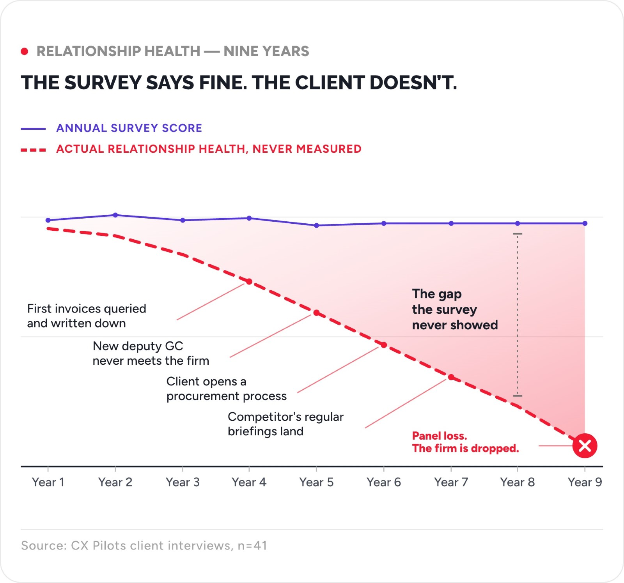
This is a real client we worked with, a manufacturing company that had used the same regional firm for nine years. Every year, the client scored the relationship a 9 out of 10. Warm notes, high marks on responsiveness, no complaints. By every measure the firm tracked, the account was healthy.
Underneath that score, the relationship was already ending. A new deputy general counsel joined and never met anyone at the firm. Invoices got vaguer, then started getting queried and quietly written down. The client opened a procurement process the firm was never invited into. A younger competing firm in the same city spent a year sending sharp, useful regulatory briefings full of relevant insights to win their business while the incumbent firm sent holiday cards and high-end chocolate chip cookies. Matters opened declined quarter over quarter, and nobody at the firm had a view into the right data to flag it. Four months passed without anyone speaking to the general counsel. Then a piece of work went to that faster-growing competitor who showed more hustle and acted like they understood the distinction between earned and entitled.
Eighteen months after the last 9-out-of-10 score, the general counsel called to say the firm hadn't made the panel. A satisfaction score was never built to catch what happened. Annual feedback is a photograph taken last winter, applied to a relationship that changes week to week. Once the score becomes the goal instead of the relationship, Goodhart's Law takes over: the firm manages the number, and the real state of the relationship erodes underneath it, unseen.
BTI Consulting has found that nearly three clients in four want to have this conversation with their outside counsel. Fewer than one firm in three actually starts it.
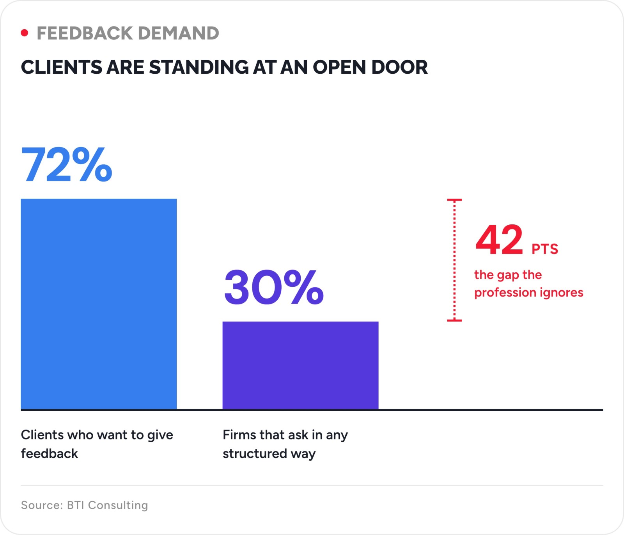
That gap sits there, unclaimed, for a simple reason: clients aren't burdened by being asked for feedback. Bad questions burden them. Ask something that reflects genuine curiosity about the relationship, instead of a generic satisfaction scale, and people lean in. We hear versions of the same complaint constantly from clients of law firms: they're surprised their own outside counsel isn't asking more interesting questions about the relationship, questions that go deeper than what a car dealership or dry cleaner might ask a customer.
When we examine how firms actually run this, the same five structural failures show up, over and over. The questions themselves are wrong: loyalty questions asked too early and too generically produce an attitudinal snapshot of whether someone's annoyed this week, rather than a behavioral signal of what they're actually about to do. The timing is wrong: a once-a-year reading can't catch a relationship that turns in a single quarter. The respondents are wrong: friendly day-to-day contacts rarely decide who stays on the panel, while the general counsel who owns the budget, the practice-area deputies, legal operations, and procurement almost never get asked anything at all. The ownership is wrong: marketing or BD can surface an insight but usually can't act on it, and that handoff to a partner or relationship owner is where most insight dies. And the incentive is wrong: a feedback program not tied to something the firm is trying to grow reads as overhead. We've had partners describe this work, out loud, as "the arts and crafts activities the BD team does."
Each failure is fixable on its own. Together, they explain how a firm can score a 9 out of 10 in the spring and lose the account by winter.
Most firms are struggling to stand out, and most are overlooking an easy lever: institutional curiosity, the actual questions a firm asks its clients. Not asking is itself a data point, and clients read the absence exactly as you'd expect, as disinterest.
Clients store how and what a firm asks them in long-term memory. Shift from generic ratings to real, narrative questions, and clients remember the shift specifically, more than the score they gave.
Our research kept surfacing the same six themes when we asked clients of law firms what they wished their outside counsel would ask.
If you rebuilt your panel today, where would we rank, and what would move us up? What's the single most important thing we could do differently on your matters? The word "single" forces a real answerinstead of a list. What legal work are you sending elsewhere, and why not to us? Uncomfortable to ask, and worth asking anyway. When you brief your CEO or board on outside counsel, what do you say about us? Where did we make your work harder: billing, staffing, speed, communication? Giving people a menu surfaces more than an open-ended "what could we improve," since most people can'tsource their own frustration cleanly without a starting point. And finally: who else on your side should we know, and whom have we not yet met? Strikingly few firms ever ask this last one.
The client above was never asked most of these. Nobody asked about work moving elsewhere, so nobody heard about the competitor's briefings. Nobody asked who else to know, so nobody met the new deputy general counsel. The questions themselves would have surfaced the loss in time to prevent it.
People tend to conflate CX with feedback, which is a mistake. Feedback is roughly a tenth of what client experience actually is inside a firm.
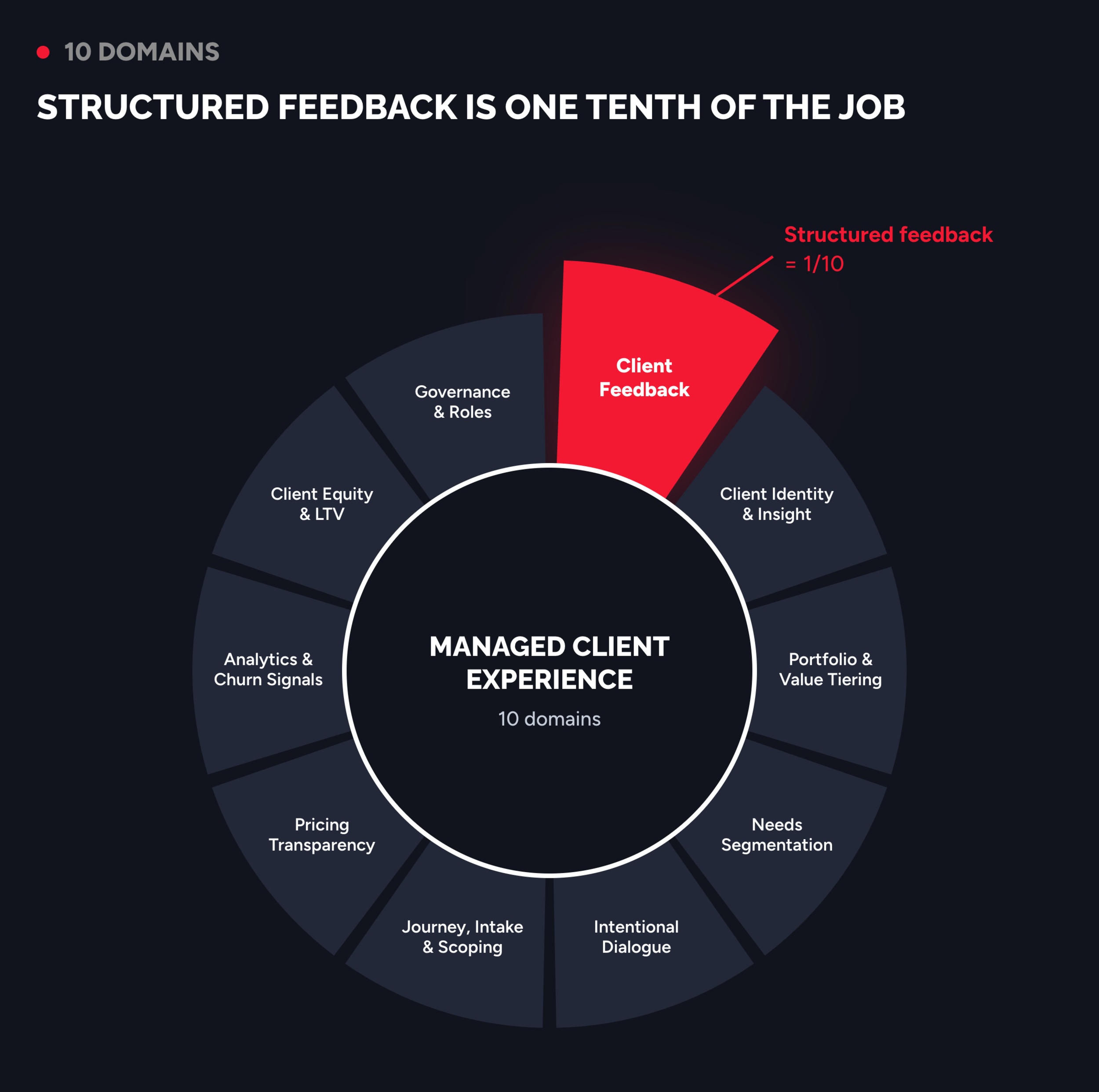
The other nine-tenths, knowing who the client really is beyond the matter, tiering the portfolio by value, designing how a matter starts, pricing with real transparency, reading billing data for early churn signals, sit almost entirely unmanaged at most firms. Managed well, feedback becomes fuel for the other nine. Managed poorly, it's the only instrument a firm has, and it's pointed in the wrong direction.
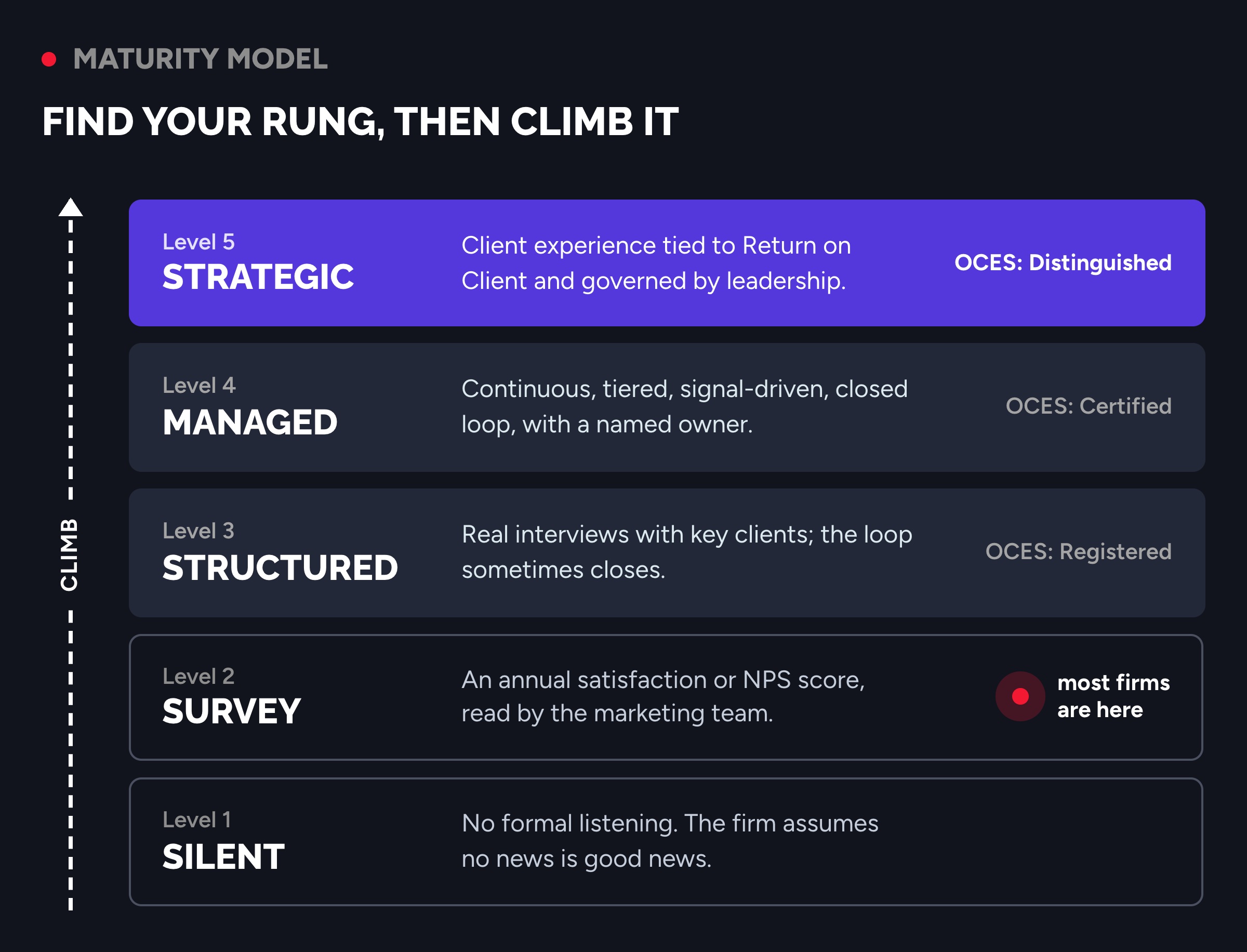
Most firms aren't starting from zero. Most sit at what we call level two: an annual survey, maybe a round of interviews. Level four, continuous, tiered, signal-driven listening with a named owner and a closed loop, is where a firm managing this well ends up. That progression, and the tools to get there, is the subject of my book, From Clients to Capital.
Ask firm leadership what it would be worth to save one key panel spot a year, and the answers come back fast: millions, multiples of whatever the program would cost. Nobody hesitates on the number. Proving it in advance is the harder part, which is why we tie this work directly to revenue at risk rather than satisfaction scores. Once the people holding the budget see the economics, the program stops reading as overhead and gets treated as a core function, on par with marketing, on par with conflicts.
None of this requires a five-year program or new software. A single quarter, applied with discipline, is enough.
In the first thirty days: choose six questions, pick 10 to 15 key clients, and map who actually decides on each account. Over the following month: senior partners run the conversations while the team pulls billing and matter signals in parallel. In the final thirty days: turn what was heard into two or three moves, give each an owner and a deadline, and tell every client who spoke what changed.
Firms with thousands of clients raise the obvious objection, and tiering answers it. Start with the top accounts, or one willing practice group. Partners tend to get on board quickly once real value comes back.
This article covers the diagnosis. The full report, The Broken Curiosity of Law Firms, covers the build, in more depth than a single article can hold. It includes the five-level maturity model, with a short self-assessment to locate exactly where a firm sits today, beyond a rough guess at level two.
The report also answers the confidentiality objection directly, since lawyers often assume ethics rules limit what they can ask clients, and they don't. It previews the Outside Counsel Experience Standard, a credentialing framework we believe is coming to legal, modeled on how the Mansfield Rule changed firm behavior once corporate buyers started requiring it. It lays out the full closed-loop protocol with specific timing for each step, capture within 48 hours, decide within a week, act within 30 days, so closing the loop becomes a checklist rather than an aspiration. And it makes the complete money case, with real figures for what a listening program costs against what a single cooling key relationship has at stake, built to hand directly to whoever controls the budget.
If any of this surfaced something real for your firm, a client you're worried about, a program that's stalled, a partner who isn't convinced, we're offering free 30-minute consults over the next few weeks. Book a time with me here.
— Steven Keith, Founder, CX Pilots. From Clients to Capital is available now on Amazon.

I've spent twenty years building client experience programs for high-trust professional services firms. My team has run tens of thousands of client interviews across AmLaw 200 firms, and one number keeps showing up in that work: only 1 in 24 clients with a problem will actually tell you. About half of the other 23 quietly take their work elsewhere.
Across that work, I've never once traced a lost client back to the quality of the legal work. It's always something quieter: an invoice nobody explained, a matter that went dark, the silence after the final bill. Firms lose clients they were certain they had, and the damage almost always gets dismissed as "soft skills" stuff, right up until it shows up as a lost panel spot.
A client relationship produces two very different readings over time: what the annual survey says, and what's actually happening underneath it. The two rarely move together for long.
This is a real client we worked with, a manufacturing company that had used the same regional firm for nine years. Every year, the client scored the relationship a 9 out of 10. Warm notes, high marks on responsiveness, no complaints. By every measure the firm tracked, the account was healthy.
Underneath that score, the relationship was already ending. A new deputy general counsel joined and never met anyone at the firm. Invoices got vaguer, then started getting queried and quietly written down. The client opened a procurement process the firm was never invited into. A younger competing firm in the same city spent a year sending sharp, useful regulatory briefings full of relevant insights to win their business while the incumbent firm sent holiday cards and high-end chocolate chip cookies. Matters opened declined quarter over quarter, and nobody at the firm had a view into the right data to flag it. Four months passed without anyone speaking to the general counsel. Then a piece of work went to that faster-growing competitor who showed more hustle and acted like they understood the distinction between earned and entitled.
Eighteen months after the last 9-out-of-10 score, the general counsel called to say the firm hadn't made the panel. A satisfaction score was never built to catch what happened. Annual feedback is a photograph taken last winter, applied to a relationship that changes week to week. Once the score becomes the goal instead of the relationship, Goodhart's Law takes over: the firm manages the number, and the real state of the relationship erodes underneath it, unseen.
BTI Consulting has found that nearly three clients in four want to have this conversation with their outside counsel. Fewer than one firm in three actually starts it.
That gap sits there, unclaimed, for a simple reason: clients aren't burdened by being asked for feedback. Bad questions burden them. Ask something that reflects genuine curiosity about the relationship, instead of a generic satisfaction scale, and people lean in. We hear versions of the same complaint constantly from clients of law firms: they're surprised their own outside counsel isn't asking more interesting questions about the relationship, questions that go deeper than what a car dealership or dry cleaner might ask a customer.
When we examine how firms actually run this, the same five structural failures show up, over and over. The questions themselves are wrong: loyalty questions asked too early and too generically produce an attitudinal snapshot of whether someone's annoyed this week, rather than a behavioral signal of what they're actually about to do. The timing is wrong: a once-a-year reading can't catch a relationship that turns in a single quarter. The respondents are wrong: friendly day-to-day contacts rarely decide who stays on the panel, while the general counsel who owns the budget, the practice-area deputies, legal operations, and procurement almost never get asked anything at all. The ownership is wrong: marketing or BD can surface an insight but usually can't act on it, and that handoff to a partner or relationship owner is where most insight dies. And the incentive is wrong: a feedback program not tied to something the firm is trying to grow reads as overhead. We've had partners describe this work, out loud, as "the arts and crafts activities the BD team does."
Each failure is fixable on its own. Together, they explain how a firm can score a 9 out of 10 in the spring and lose the account by winter.
Most firms are struggling to stand out, and most are overlooking an easy lever: institutional curiosity, the actual questions a firm asks its clients. Not asking is itself a data point, and clients read the absence exactly as you'd expect, as disinterest.
Clients store how and what a firm asks them in long-term memory. Shift from generic ratings to real, narrative questions, and clients remember the shift specifically, more than the score they gave.
Our research kept surfacing the same six themes when we asked clients of law firms what they wished their outside counsel would ask.
If you rebuilt your panel today, where would we rank, and what would move us up? What's the single most important thing we could do differently on your matters? The word "single" forces a real answerinstead of a list. What legal work are you sending elsewhere, and why not to us? Uncomfortable to ask, and worth asking anyway. When you brief your CEO or board on outside counsel, what do you say about us? Where did we make your work harder: billing, staffing, speed, communication? Giving people a menu surfaces more than an open-ended "what could we improve," since most people can'tsource their own frustration cleanly without a starting point. And finally: who else on your side should we know, and whom have we not yet met? Strikingly few firms ever ask this last one.
The client above was never asked most of these. Nobody asked about work moving elsewhere, so nobody heard about the competitor's briefings. Nobody asked who else to know, so nobody met the new deputy general counsel. The questions themselves would have surfaced the loss in time to prevent it.
People tend to conflate CX with feedback, which is a mistake. Feedback is roughly a tenth of what client experience actually is inside a firm.
The other nine-tenths, knowing who the client really is beyond the matter, tiering the portfolio by value, designing how a matter starts, pricing with real transparency, reading billing data for early churn signals, sit almost entirely unmanaged at most firms. Managed well, feedback becomes fuel for the other nine. Managed poorly, it's the only instrument a firm has, and it's pointed in the wrong direction.
Most firms aren't starting from zero. Most sit at what we call level two: an annual survey, maybe a round of interviews. Level four, continuous, tiered, signal-driven listening with a named owner and a closed loop, is where a firm managing this well ends up. That progression, and the tools to get there, is the subject of my book, From Clients to Capital.
Ask firm leadership what it would be worth to save one key panel spot a year, and the answers come back fast: millions, multiples of whatever the program would cost. Nobody hesitates on the number. Proving it in advance is the harder part, which is why we tie this work directly to revenue at risk rather than satisfaction scores. Once the people holding the budget see the economics, the program stops reading as overhead and gets treated as a core function, on par with marketing, on par with conflicts.
None of this requires a five-year program or new software. A single quarter, applied with discipline, is enough.
In the first thirty days: choose six questions, pick 10 to 15 key clients, and map who actually decides on each account. Over the following month: senior partners run the conversations while the team pulls billing and matter signals in parallel. In the final thirty days: turn what was heard into two or three moves, give each an owner and a deadline, and tell every client who spoke what changed.
Firms with thousands of clients raise the obvious objection, and tiering answers it. Start with the top accounts, or one willing practice group. Partners tend to get on board quickly once real value comes back.
This article covers the diagnosis. The full report, The Broken Curiosity of Law Firms, covers the build, in more depth than a single article can hold. It includes the five-level maturity model, with a short self-assessment to locate exactly where a firm sits today, beyond a rough guess at level two.
The report also answers the confidentiality objection directly, since lawyers often assume ethics rules limit what they can ask clients, and they don't. It previews the Outside Counsel Experience Standard, a credentialing framework we believe is coming to legal, modeled on how the Mansfield Rule changed firm behavior once corporate buyers started requiring it. It lays out the full closed-loop protocol with specific timing for each step, capture within 48 hours, decide within a week, act within 30 days, so closing the loop becomes a checklist rather than an aspiration. And it makes the complete money case, with real figures for what a listening program costs against what a single cooling key relationship has at stake, built to hand directly to whoever controls the budget.
If any of this surfaced something real for your firm, a client you're worried about, a program that's stalled, a partner who isn't convinced, we're offering free 30-minute consults over the next few weeks. Book a time with me here.
— Steven Keith, Founder, CX Pilots. From Clients to Capital is available now on Amazon.