When a managing partner says "we won," they usually mean a moment. The firm competed against several others and was selected. That is winning the work.
Winning the client is a different achievement. It builds over hundreds or thousands of interactions: emails, meetings, phone calls, documents passed back and forth, mistakes made and recovered from. Each one leaves the experience of working with the firm a little more positive, neutral, or negative. The outcome illusion, a common blind spot in professional services client experience, is treating the first win as proof of the second.
Professional services firms obsess over technical quality. In legal, how a matter is managed matters. In accounting, how the audit fieldwork is run matters.
Clients remember something else. Across thousands of client feedback interviews, the pattern is consistent: when clients recount working with a firm, they can rarely recall specifics about the quality of the work. They recall how the work went. How people interacted, how they managed time, how they managed expectations, and whether the engagement left them reassured, frustrated, or worried.
The mechanism is simple. Accounting, legal, and advisory services are credence goods: buyers struggle to verify the quality of what they received, even after delivery. So they evaluate proxies they can see: responsiveness and attentiveness, predictable fees, whether the lead people understand the client's business and revenue model, how the junior team shows up, and how predictable the communication is. Those proxies live in the gap between winning the work and winning the client.
In legal, the general counsel hires the law firm, and the business unit lives with the deal. In accounting, the CFO hires the auditor, and the controller's team lives through the fieldwork.
The rehire decision draws on both groups. Most firms focus on the technical reason they were hired (winning the matter, completing the audit) and leave the rehire process unexamined. Few map how that decision unfolds, who shapes it, or how to engineer affinity among the people who live with the work every day.
A mid-sized accounting and business advisory firm, with about 800 employees, had built a strong advisory practice, including cybersecurity and HR and recruiting arms serving the managed services sector. It won one of the largest IT integrators in its region, a landmark account for the firm.
The firm celebrated, as it should have. Then the win became a belief: if we can land an account this size, we can land another. Business development turned its attention to the next big win.
Meanwhile, the new client started to feel underattended. People rotated on and off the account. Buyer's remorse set in, and within a year the client moved its work to another firm. The firm won the account and lost the client.
Every proxy the client could judge (attention, continuity, a team that understood its business) failed in that first year. The technical work may well have been excellent, and the client had no way to tell.
When a firm wins an account, it measures what is convenient: who originated it, how much the client is likely to spend, how to staff and bill the work, and what it means for firm financials. Those numbers have real value.
Return on client (ROC), a framework from founder Steven Keith’s book From Clients to Capital, asks a different question. How should the firm invest in this new relationship so the client sees maximum reciprocal value over time? ROC treats the client relationship as the firm's most valuable financial asset and measures it with the same rigor firms apply to realization and profits per partner.
Firms are built to celebrate transactions. "We won the account. Good job, Michael." The slow, methodical expansion of that account through a string of positive experiences rarely gets the same recognition, because slow-moving progress is harder to see. ROC makes that progress visible.
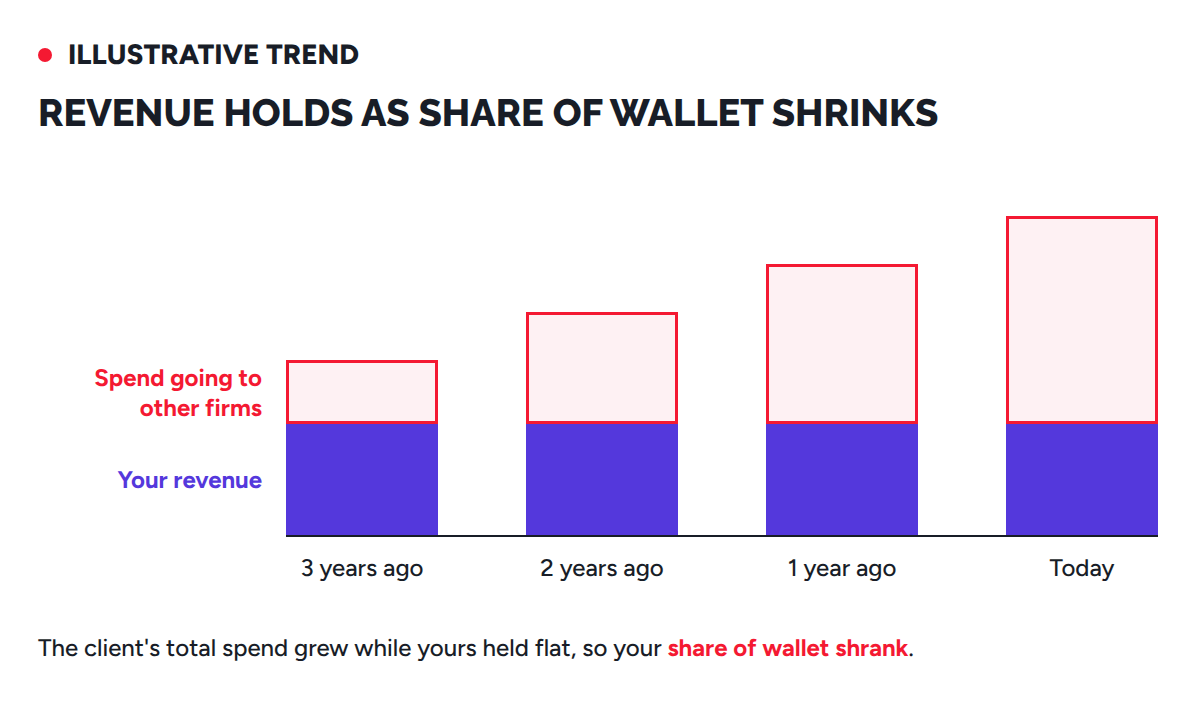
Revenue from a client can hold steady while share of wallet shrinks beneath it.
Many enterprise clients, by mandate, spread their legal, accounting, and consulting work across several firms to hedge risk. Smaller clients often give one firm all of their work, but they spend less. So the firms pursuing the largest clients accept that those clients are also working with several firms just like theirs. The growth question becomes: what builds enough equity in the relationship that the client chooses to move more of its spend to you?
The outcome illusion has a partner: survivorship evidence. "We won, they paid, they came back." The managing partner sees the client who returned and never sees the share of spend the firm failed to win.
Churn usually signals itself before it happens. Total spend declines, and team handoffs pile up. One of the clearest signals is a client asking the firm's billing department to resend every invoice from the past three years: someone inside the client is usually building a case to move the account or significant chunks of it.
One question cuts through all of it: what share of this client's outside spend do you hold today, and what was it three years ago? The answer tells a story of growth, stagnation, or decline. The Accounting Churn Calculator can help put a number on what that decline costs.
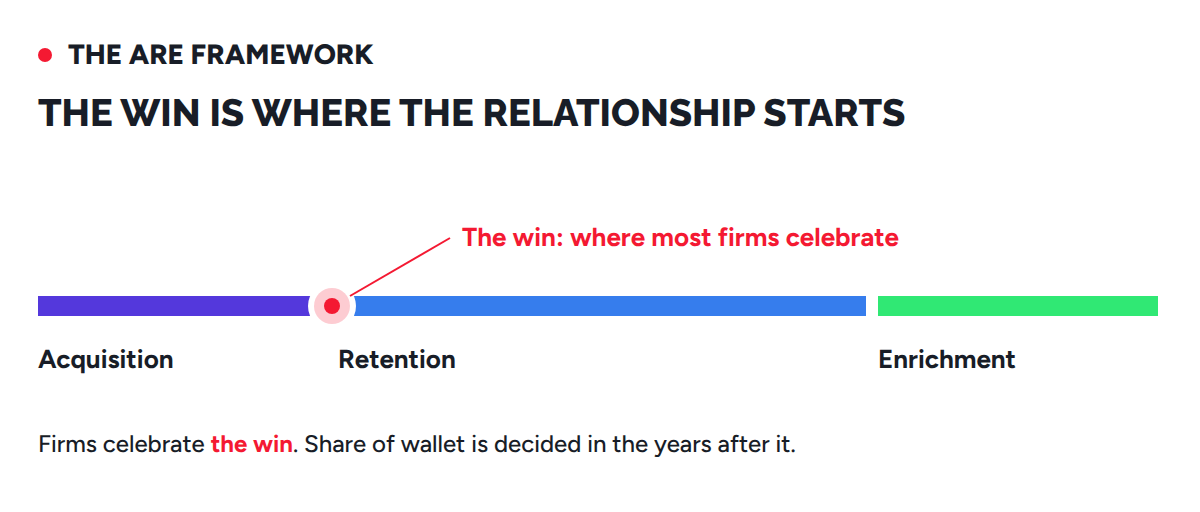
At CX Pilots, we organize the experiences clients have outside the technical work into three stages, which we call A.R.E.
Acquisition is the buyer's experience: the magnetism or pull of the firm's brand, its marketing materials, the pitch, the lunches, dinners and drinks, and every conversation leading up to the hiring decision.
Retention is holding on: it is the bulk of the client's journey with the firm, and the deliberate client retention work that keeps the client there.
Enrichment is growth with existing clients into other services. In a law firm, that means moving from corporate into IP, and from IP into tax. In an accounting firm, it means moving from tax to audit, and from audit to business advisory.
Each stage has its own experiences to design, and each one builds or drains the equity that decides share of wallet.
Two years after a matter closes or an engagement wraps, a won client is a relationship in good condition. Beyond the economics, the client trusts the firm.
Trust is hard to measure, and conventional client surveys measure it poorly. Our 2026 client experience report, The Broken Curiosity of Law Firms, lays out why most firms ask the wrong questions, of the wrong people, for the wrong reasons, at the wrong time.
Winning the client takes infrastructure: a way to manage and measure trust, more strategic questions that bring back useful answers, and data that arrives early enough to shape the relationship while there is still time. Firms that build it develop client relationships with more energy than they put into winning discrete projects, and their share of wallet shows it.
The outcome illusion is treating a won engagement as proof of a won client. Winning the work is a single selection event. Winning the client builds over many interactions and shows up in rehiring, expanded work, and a growing share of the client's spend.
Return on client is a framework from founder Steven Keith’s book From Clients to Capital. It treats each client relationship as a financial asset to invest in, measured over the life of the relationship with the same rigor firms apply to realization and profits per partner.
Clients struggle to judge the technical quality of accounting, legal, or advisory work, so they judge proxies: responsiveness, fee predictability, team continuity, and whether the firm understands their business. When those proxies fail, clients leave regardless of the quality of the work.
Common signals include declining total spend, frequent team handoffs, and requests to resend historical invoices, which often means the client is building an internal case to move the account.
Compare the share of the client's total outside spend your firm holds today with the share it held three years ago. The trend shows whether the relationship is growing, stagnating, or declining.
Go deeper on return on client and the frameworks behind it in From Clients to Capital. Download the first chapter free, or talk with our team about measuring your client relationships.

When a managing partner says "we won," they usually mean a moment. The firm competed against several others and was selected. That is winning the work.
Winning the client is a different achievement. It builds over hundreds or thousands of interactions: emails, meetings, phone calls, documents passed back and forth, mistakes made and recovered from. Each one leaves the experience of working with the firm a little more positive, neutral, or negative. The outcome illusion, a common blind spot in professional services client experience, is treating the first win as proof of the second.
Professional services firms obsess over technical quality. In legal, how a matter is managed matters. In accounting, how the audit fieldwork is run matters.
Clients remember something else. Across thousands of client feedback interviews, the pattern is consistent: when clients recount working with a firm, they can rarely recall specifics about the quality of the work. They recall how the work went. How people interacted, how they managed time, how they managed expectations, and whether the engagement left them reassured, frustrated, or worried.
The mechanism is simple. Accounting, legal, and advisory services are credence goods: buyers struggle to verify the quality of what they received, even after delivery. So they evaluate proxies they can see: responsiveness and attentiveness, predictable fees, whether the lead people understand the client's business and revenue model, how the junior team shows up, and how predictable the communication is. Those proxies live in the gap between winning the work and winning the client.
In legal, the general counsel hires the law firm, and the business unit lives with the deal. In accounting, the CFO hires the auditor, and the controller's team lives through the fieldwork.
The rehire decision draws on both groups. Most firms focus on the technical reason they were hired (winning the matter, completing the audit) and leave the rehire process unexamined. Few map how that decision unfolds, who shapes it, or how to engineer affinity among the people who live with the work every day.
A mid-sized accounting and business advisory firm, with about 800 employees, had built a strong advisory practice, including cybersecurity and HR and recruiting arms serving the managed services sector. It won one of the largest IT integrators in its region, a landmark account for the firm.
The firm celebrated, as it should have. Then the win became a belief: if we can land an account this size, we can land another. Business development turned its attention to the next big win.
Meanwhile, the new client started to feel underattended. People rotated on and off the account. Buyer's remorse set in, and within a year the client moved its work to another firm. The firm won the account and lost the client.
Every proxy the client could judge (attention, continuity, a team that understood its business) failed in that first year. The technical work may well have been excellent, and the client had no way to tell.
When a firm wins an account, it measures what is convenient: who originated it, how much the client is likely to spend, how to staff and bill the work, and what it means for firm financials. Those numbers have real value.
Return on client (ROC), a framework from founder Steven Keith’s book From Clients to Capital, asks a different question. How should the firm invest in this new relationship so the client sees maximum reciprocal value over time? ROC treats the client relationship as the firm's most valuable financial asset and measures it with the same rigor firms apply to realization and profits per partner.
Firms are built to celebrate transactions. "We won the account. Good job, Michael." The slow, methodical expansion of that account through a string of positive experiences rarely gets the same recognition, because slow-moving progress is harder to see. ROC makes that progress visible.
Revenue from a client can hold steady while share of wallet shrinks beneath it.
Many enterprise clients, by mandate, spread their legal, accounting, and consulting work across several firms to hedge risk. Smaller clients often give one firm all of their work, but they spend less. So the firms pursuing the largest clients accept that those clients are also working with several firms just like theirs. The growth question becomes: what builds enough equity in the relationship that the client chooses to move more of its spend to you?
The outcome illusion has a partner: survivorship evidence. "We won, they paid, they came back." The managing partner sees the client who returned and never sees the share of spend the firm failed to win.
Churn usually signals itself before it happens. Total spend declines, and team handoffs pile up. One of the clearest signals is a client asking the firm's billing department to resend every invoice from the past three years: someone inside the client is usually building a case to move the account or significant chunks of it.
One question cuts through all of it: what share of this client's outside spend do you hold today, and what was it three years ago? The answer tells a story of growth, stagnation, or decline. The Accounting Churn Calculator can help put a number on what that decline costs.
At CX Pilots, we organize the experiences clients have outside the technical work into three stages, which we call A.R.E.
Acquisition is the buyer's experience: the magnetism or pull of the firm's brand, its marketing materials, the pitch, the lunches, dinners and drinks, and every conversation leading up to the hiring decision.
Retention is holding on: it is the bulk of the client's journey with the firm, and the deliberate client retention work that keeps the client there.
Enrichment is growth with existing clients into other services. In a law firm, that means moving from corporate into IP, and from IP into tax. In an accounting firm, it means moving from tax to audit, and from audit to business advisory.
Each stage has its own experiences to design, and each one builds or drains the equity that decides share of wallet.
Two years after a matter closes or an engagement wraps, a won client is a relationship in good condition. Beyond the economics, the client trusts the firm.
Trust is hard to measure, and conventional client surveys measure it poorly. Our 2026 client experience report, The Broken Curiosity of Law Firms, lays out why most firms ask the wrong questions, of the wrong people, for the wrong reasons, at the wrong time.
Winning the client takes infrastructure: a way to manage and measure trust, more strategic questions that bring back useful answers, and data that arrives early enough to shape the relationship while there is still time. Firms that build it develop client relationships with more energy than they put into winning discrete projects, and their share of wallet shows it.
The outcome illusion is treating a won engagement as proof of a won client. Winning the work is a single selection event. Winning the client builds over many interactions and shows up in rehiring, expanded work, and a growing share of the client's spend.
Return on client is a framework from founder Steven Keith’s book From Clients to Capital. It treats each client relationship as a financial asset to invest in, measured over the life of the relationship with the same rigor firms apply to realization and profits per partner.
Clients struggle to judge the technical quality of accounting, legal, or advisory work, so they judge proxies: responsiveness, fee predictability, team continuity, and whether the firm understands their business. When those proxies fail, clients leave regardless of the quality of the work.
Common signals include declining total spend, frequent team handoffs, and requests to resend historical invoices, which often means the client is building an internal case to move the account.
Compare the share of the client's total outside spend your firm holds today with the share it held three years ago. The trend shows whether the relationship is growing, stagnating, or declining.
Go deeper on return on client and the frameworks behind it in From Clients to Capital. Download the first chapter free, or talk with our team about measuring your client relationships.


