


Most managed CX programs in services firms look healthy from the steering committee. The survey goes out on schedule. The dashboard refreshes.
Then a policyholder calls about a stalled claim, or a general counsel waits a week and a half for a matter update, and none of that machinery touches the moment that decides whether the client stays.
CX Pilots has watched this across carriers, law firms, accounting firms, and engineering practices. The strategy is usually sound. The program breaks in operations, at five predictable points, and the fix is a CX operating model.
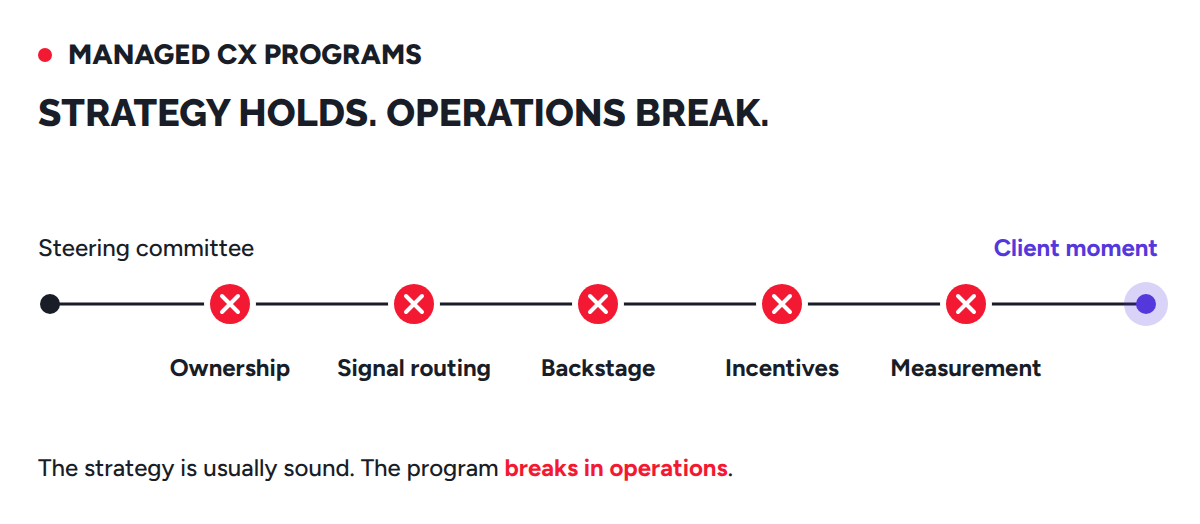
Most programs have an owner. Very few moments do. The CX lead owns the survey and the readout. Nobody owns the stretch between first notice of loss and the adjuster's first call, or between the signed engagement letter and the first substantive partner conversation.
When a moment has no owner, every function can show its own piece worked. Intake hit its SLA. The client still had a bad experience, and the org chart has no line for it.
Feedback without routing is a reporting exercise. A verbatim that says "I had to explain my situation three times" needs to reach whoever owns the handoff that caused it, with a deadline. In most programs it reaches a dashboard, where it becomes a theme, then a slide.
The test we use: pull ten pieces of negative feedback from last quarter and trace what happened to each one. If the answer is mostly "it was reported," the program is listening without operating.
Clients feel the front stage. The failures behind bad moments sit backstage, in work queues, file transfers between offices, vendor assignments, and conflict checks. A program that measures only the front stage keeps diagnosing symptoms. Service blueprinting exposes the internal sequence behind each client moment, so the fix lands on the cause.
An adjuster measured on closures per week will rush the conversation that would have prevented the complaint. An associate measured on billable hours has every reason to skip the thirty unbilled minutes it takes to call a client and explain where the matter stands. Culture follows the scorecard. When the program asks people to behave one way and the compensation model rewards another, the compensation model wins.
Quarterly relationship scores arrive too late and too aggregated to change anything. Operations needs signal by moment, office, and team, at the speed the work moves.
The firms that turn CX into a durable advantage build four things, in this order.
.png)
They name the small set of moments that decide retention and expansion, set a standard for each, and blueprint the backstage work behind it. Every office then works from the same definition of good, which is how an experience scales beyond the few people who deliver it well today.
Each moment has an owner who can change the process, the staffing, or the handoff. Ownership carries budget authority, or it is an honorific.
Signal routes to the owner of the moment with a close-the-loop deadline. A monthly operating review sets moment-level performance beside the operational metrics driving it, and ends in decisions.
Frontline and professional staff carry experience measures in their own goals, weighted enough to matter. Leaders reinforce it in whom they promote.
In services, the offering itself rarely separates firms. Coverage forms converge. Enterprise-tier legal and accounting expertise is broadly comparable, and buyers assume it. What drives renewal, panel retention, and referral is how the work felt to receive: whether clients knew what was happening, whether someone owned their problem, and whether the firm behaved like one firm.
The operating model produces that experience. A competitor can copy your survey or journey map in a quarter. An operating model with clear ownership, working signal routing, and aligned incentives takes years to build, which is exactly why it holds. It is also the only credible answer to how a growing firm keeps the experience consistent as it adds offices, lines, and people.
Pick the one moment where you lose the most clients or the most margin. Name an owner with authority to change it. Blueprint the backstage. Route every relevant piece of feedback to that owner for ninety days and review it monthly.
That single moment will teach you more about your program's real constraints than another year of quarterly scores.
A CX operating model is the structure that connects a professional services firm's CX program to daily operations. It has four parts: a defined service-experience model, named owners with decision rights for each key moment, feedback routed to those owners with close-the-loop deadlines, and scorecards that carry experience measures.
Most programs own the survey and the readout, while the moments that decide retention sit in operations with no owner. Feedback stops at a dashboard, short of the person who can fix the handoff, and incentives often reward the behavior that causes complaints.
Service blueprinting maps the backstage work behind each client moment, such as work queues, file transfers, vendor assignments, and conflict checks. It shows where an experience actually fails, so the fix lands on the cause.
Closed-loop feedback routes each relevant piece of client feedback to the owner of the moment that caused it, with a deadline, and reviews results in a monthly operating review. A quick test: trace ten pieces of last quarter's negative feedback and see how many led to a change.
Start with the one moment where you lose the most clients or margin. Name an owner with authority to change it, blueprint the backstage work, and route all related feedback to that owner for ninety days.
Named ownership only works with governance behind it. Our CX Governance Insight Report lays out how to build the decision-making body that gives moment owners real authority. Download the CX Governance Insight Report, or talk with our team about your program.

Most managed CX programs in services firms look healthy from the steering committee. The survey goes out on schedule. The dashboard refreshes.
Then a policyholder calls about a stalled claim, or a general counsel waits a week and a half for a matter update, and none of that machinery touches the moment that decides whether the client stays.
CX Pilots has watched this across carriers, law firms, accounting firms, and engineering practices. The strategy is usually sound. The program breaks in operations, at five predictable points, and the fix is a CX operating model.
Most programs have an owner. Very few moments do. The CX lead owns the survey and the readout. Nobody owns the stretch between first notice of loss and the adjuster's first call, or between the signed engagement letter and the first substantive partner conversation.
When a moment has no owner, every function can show its own piece worked. Intake hit its SLA. The client still had a bad experience, and the org chart has no line for it.
Feedback without routing is a reporting exercise. A verbatim that says "I had to explain my situation three times" needs to reach whoever owns the handoff that caused it, with a deadline. In most programs it reaches a dashboard, where it becomes a theme, then a slide.
The test we use: pull ten pieces of negative feedback from last quarter and trace what happened to each one. If the answer is mostly "it was reported," the program is listening without operating.
Clients feel the front stage. The failures behind bad moments sit backstage, in work queues, file transfers between offices, vendor assignments, and conflict checks. A program that measures only the front stage keeps diagnosing symptoms. Service blueprinting exposes the internal sequence behind each client moment, so the fix lands on the cause.
An adjuster measured on closures per week will rush the conversation that would have prevented the complaint. An associate measured on billable hours has every reason to skip the thirty unbilled minutes it takes to call a client and explain where the matter stands. Culture follows the scorecard. When the program asks people to behave one way and the compensation model rewards another, the compensation model wins.
Quarterly relationship scores arrive too late and too aggregated to change anything. Operations needs signal by moment, office, and team, at the speed the work moves.
The firms that turn CX into a durable advantage build four things, in this order.
They name the small set of moments that decide retention and expansion, set a standard for each, and blueprint the backstage work behind it. Every office then works from the same definition of good, which is how an experience scales beyond the few people who deliver it well today.
Each moment has an owner who can change the process, the staffing, or the handoff. Ownership carries budget authority, or it is an honorific.
Signal routes to the owner of the moment with a close-the-loop deadline. A monthly operating review sets moment-level performance beside the operational metrics driving it, and ends in decisions.
Frontline and professional staff carry experience measures in their own goals, weighted enough to matter. Leaders reinforce it in whom they promote.
In services, the offering itself rarely separates firms. Coverage forms converge. Enterprise-tier legal and accounting expertise is broadly comparable, and buyers assume it. What drives renewal, panel retention, and referral is how the work felt to receive: whether clients knew what was happening, whether someone owned their problem, and whether the firm behaved like one firm.
The operating model produces that experience. A competitor can copy your survey or journey map in a quarter. An operating model with clear ownership, working signal routing, and aligned incentives takes years to build, which is exactly why it holds. It is also the only credible answer to how a growing firm keeps the experience consistent as it adds offices, lines, and people.
Pick the one moment where you lose the most clients or the most margin. Name an owner with authority to change it. Blueprint the backstage. Route every relevant piece of feedback to that owner for ninety days and review it monthly.
That single moment will teach you more about your program's real constraints than another year of quarterly scores.
A CX operating model is the structure that connects a professional services firm's CX program to daily operations. It has four parts: a defined service-experience model, named owners with decision rights for each key moment, feedback routed to those owners with close-the-loop deadlines, and scorecards that carry experience measures.
Most programs own the survey and the readout, while the moments that decide retention sit in operations with no owner. Feedback stops at a dashboard, short of the person who can fix the handoff, and incentives often reward the behavior that causes complaints.
Service blueprinting maps the backstage work behind each client moment, such as work queues, file transfers, vendor assignments, and conflict checks. It shows where an experience actually fails, so the fix lands on the cause.
Closed-loop feedback routes each relevant piece of client feedback to the owner of the moment that caused it, with a deadline, and reviews results in a monthly operating review. A quick test: trace ten pieces of last quarter's negative feedback and see how many led to a change.
Start with the one moment where you lose the most clients or margin. Name an owner with authority to change it, blueprint the backstage work, and route all related feedback to that owner for ninety days.
Named ownership only works with governance behind it. Our CX Governance Insight Report lays out how to build the decision-making body that gives moment owners real authority. Download the CX Governance Insight Report, or talk with our team about your program.

